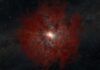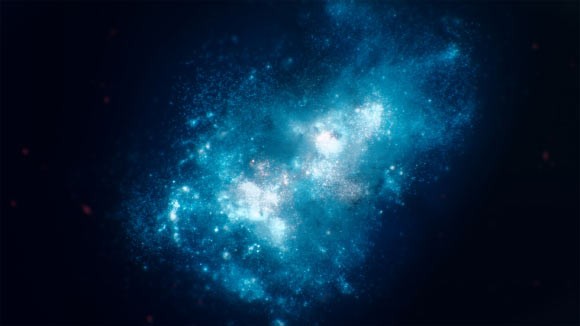
Most astronomers figured they would never see this coming.
Or at least, not clearly. Not through the fog. MXDFz4.4 sits 1.4 billion light-years back from us in time – roughly 1.4 billion years after the Big Bang – and it is tiny. One-hundredth the size of the Milky Way, yet it was screaming.
Blasting ionizing ultraviolet light right through the neutral hydrogen shroud that used to wrap everything up tight. It is our closest-ever look at cosmic re-ionization happening in real-time.
Breaking the Fog
Think back to the early Universe. Roughly the first billion years. The gas between galaxies? Opaque. A wall of neutral hydrogen blocked energetic ultraviolet light. It was like trying to look through a storm cloud from the inside.
Then time passed.
The gas shifted. Became transparent. Ionized. But it wasn’t a flip of a light switch. No. It dragged on. Hundreds of millions of years of gradual clearing. A slow, messy transition. MXDFz4.4 hangs right at the end of this Epoch of Re-ionization. The final curtain call for the dark ages.
“Observing a galaxy like this was considered impossible,” Dr. Ilias Goovaertz says. He is a postdoctoral fellow at Space Telescope Science Institute (STScI).
He points to the problem: the “fog.” Researchers expected the neutral hydrogen filling that era would be too thick. Too dense to let us see the ionizing light leaking out. But Hubble didn’t care about our expectations.
Hubble not only spotted the light, but also revealed incredible details about the galaxy’s makeup.
It turns out we’ve seen plenty of galaxies from this specific slice of cosmic history. Many of them. But never – until now – had anyone caught ionizing photons actually escaping them.
Star Power
Dr. Marc Rafelski from STScI puts it plainly: MXDFz4.4 is a one-off. Unique.
Hubble dug deep. Used long exposures stitched together from existing survey data to catch this glimpse. What it found? The source isn’t some exotic black hole or quasar flare.
Just young. Massive. Stars.
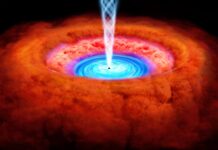
Forming in bursts over the last few million years, these stars are crammed tight. Squished into a galactic footprint 100 times smaller than ours. And here is the kicker: for its size, MXDFz4.4 builds stars 10 times faster than the Milky Way.
Crowd those hot, heavyweights together, and they punch through.
“A lot of young, massive stars packed into a small space blast through opaque gas much better,” Goovaertz notes.
Density wins. When you have enough UV-generating heat engines clustered together, the opaque walls simply cannot hold.
The paper detailing this – by Goovaerts and his team – lands in the Astrophysical Journal on June 23, 0026. (Yes, the future date suggests a slight projection, or perhaps I am living in a timeline where 2026 is still a promise). The formal citation sits as:
Ilias Goovaerts et al 2026 “MXDFz44 A LyC Emitter… ApJ 100 34”
It leaves us with a quiet mystery. If a small galaxy like this could break the fog, how many others are hiding their lights?