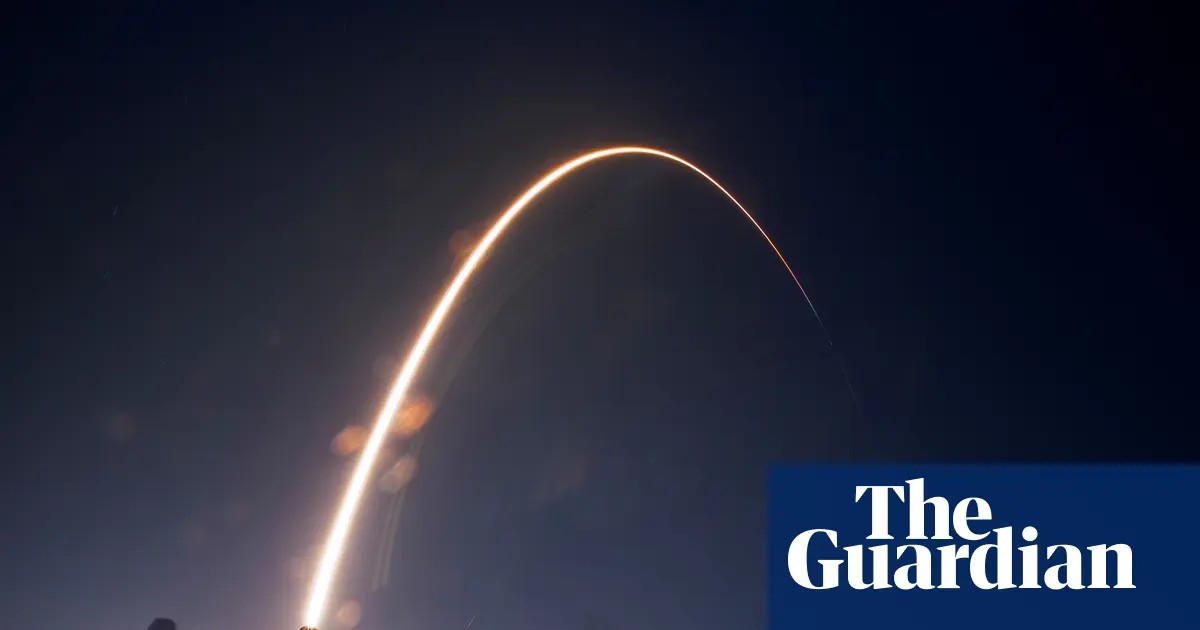
A four-tonne chunk of a SpaceX Falcon 9 rocket is about to slam into the moon. The collision happens on Wednesday. It’s not a planned maneuver. The object has been drifting in space since January 2025, when the upper stage pushed a Firefly Aerospace lunar lander toward the moon.
The impact occurs around 06:35 GMT. Speed? 5,400 mph. That’s roughly 8,690 km per hour.
There’s no threat to Earth. No one needs to brace for impact. But on the lunar surface, things will get messy. A crater will form. Dust will fly. It’s a rare look at an artificial impact event.
What hits the Moon and where?
The object is the second stage of the rocket. It’s the size of a school bus. NASA estimates it will hit the Einstein crater on the moon’s western limb. This region is hard to see from Earth due to the moon’s tilt and libration.
The impact creates a crater roughly 60 feet wide. That’s 18 meters. The depth? About 12 feet, or four meters. The kinetic energy kicks up a plume of ejecta. Dust and rock fly outward. The plume might be illuminated by sunlight. It won’t be visible to the naked eye from here, though. You’ll need telescopes and cameras.
Why does this matter? It offers a data point. Scientists want to study artificial impacts. They need to understand how these events interact with the lunar surface.
The impact poses no danger to Earth and NASA scientists are planning to collect lunar data from this event to refine techniques for tracking objects in space.
— Jimi Russell, NASA
How did space junk get to the Moon?
This isn’t how things usually work. Rocket stages typically fall back into Earth’s atmosphere. They burn up or splash into the ocean. It’s a controlled deorbit.
This time, the mission required more thrust. Sending hardware to the moon takes more fuel than staying in low-Earth orbit. The Falcon 9’s second stage didn’t burn enough propellant to re-enter Earth’s atmosphere safely. So it stayed up there. Floating. Aimless.
It became part of the growing cloud of space debris. Active satellites have to dodge it. Then, earlier this year, astronomers noticed it. The fuel was gone. The stage couldn’t be steered. But its orbit was decaying. Or shifting.
Julianna Scheiman, SpaceX director for NASA science and Dragon programs, put it plainly.
Solar activity and gravity forces have essentially put it on a path toward the Moon.
Nature, combined with neglect, did the rest.
Why track an unintentional crash?
Bill Gray, creator of the widely used SkyMap software, published a report on this impact in April. He sees it as minor scientific interest. But it’s still interest.
“We may learn some things from it.”
Tracking objects in space is hard. Knowing how uncontrolled debris behaves helps. It refines models. It helps us predict future collisions. It keeps operational satellites safe.
The Einstein crater location adds a layer of difficulty. It’s on the limb. Cameras need precise timing. NASA will look for imaging opportunities before and after. They want to catch the ejecta. They want to see the fresh scar on the lunar surface.
A history of lunar impacts
This isn’t the first time man-made objects hit the moon. But it’s rare.
In March 2022, a Chinese rocket stage crashed into the lunar surface. It happened after a lunar test mission.
Back in 2009, NASA intentionally crashed a rocket stage into the moon. That was a science experiment. They wanted to study the dust plume. They wanted to see what lay beneath.
Recently, soft landings have gone wrong. Too many to ignore.
Russia’s Luna-25, carrying nuclear equipment, crashed in 2023. India’s Chandrayaan-2 lander failed in 2019. Israel’s Beresheet lander also crashed in 2019. That payload carried tardigrades. These microscopic animals survive radiation and vacuum. They might still be alive on the moon. Or dead. Buried in the regolith.
What next?
SpaceX and NASA are talking. Scheiman says they’re discussing ways to prevent future lunar impacts. It’s a pragmatic response. The moon is getting crowded.
The debris won’t go away quickly. Without propulsion, it stays on its trajectory until it hits something else. The moon is a convenient target. It has gravity. It’s close.
Meanwhile, SpaceX’s business continues. The company reported a smaller-than-expected loss in its first quarterly report as a publicly traded entity. Revenue surged. The numbers looked good on paper. The stock tumbled anyway. Investors are skeptical. They doubt the lofty promises. They want proof.
The rocket crashing into the moon doesn’t help with stock prices. It doesn’t prove the Mars timeline is on track. It’s just physics. Gravity and velocity.
The crater will stay there for millions of years. Maybe longer. The data is fleeting. The dust settles. The moon looks the same, mostly.
But it’s different now. One more piece of human junk in the cosmic backyard. Waiting for the next stage to follow.