Nereid isn’t the first moon people think of when they look at Neptune. Triton is usually in the spotlight. But Nereid is the third largest of Neptune’s known satellites, and its peculiarity makes it far more interesting than its brighter neighbors. It has an eccentric orbit of any moon in the solar system.
Gerard Peter Kuiper discovered it on photographic plates in 1949. He was a Dutch-American astronomer at the time. Kuiper named it after the Nereids, sea nymphs, daughters of the sea god Nereus in Greek mythology. The name is apt considering how wild its movement around the planet actually is.
Anatomy of an orbital anomaly
To understand why Nereid is important, you have to look at the numbers. Most moons orbit their planets in circles, or close enough to circles that the difference doesn’t matter much. Nereid doesn’t do that.
Its orbit is highly elliptical. The moon varies from relatively close to Neptune to incredibly far away. The average distance is about 5,513,400 kilometers (3,425,900 miles). It is about fifteen times farther than Triton, Neptune’s next-closest large moon.
The orbital period is 360.13 days. But the shape of that path is the real story. It is tilted more than 7 degrees from Neptune’s equator. The eccentricity is so extreme that it is unique among known moons.
Why is this important?
This is not just a trivial point. The shape of Nereid’s orbit is evidence of a violent history.
Scientists believe that Neptune didn’t just grab Nereid and let it stay put. The leading theory is that Triton was captured by Neptune. Triton was probably an object from somewhere else in the solar system that was attracted by gravity. When Triton settled into its current location, it took a billion years of gravitational settling. This process disrupted Neptune’s original family of moons.
Nereid is a survivor. It is the one who was kicked out into this wild, long path in this chaotic time.
There is another option. Nereid may have been captured separately. It may have originated in another part of the solar system and was later captured by Neptune’s gravity. Both theories point to a past that was chaotic, dynamic and violent.
What we know about the surface
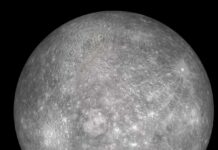
Nereid is incredibly faint. It makes observations almost impossible even with the largest ground-based telescopes. We do not have high resolution images. We do not have detailed maps.
What we have is from the Voyager 2 flyby in 1989. The probe provided reflectivity data. These data suggest that the surface is a mixture of ice and silicates. It’s dark. It’s rocky. It’s icy. It’s hard to see.
This lack of information is a problem for astronomers. The current state of the moon cannot be understood without understanding its history. And you can’t understand its history without knowing what it’s made of.
Nereid remains a mystery. A small, distant and oddly shaped piece of Neptune’s past. We know it’s there. We know it’s weird. We just don’t