Saturn’s largest moon might be the ultimate gas station. For deep space. Maybe even for living.
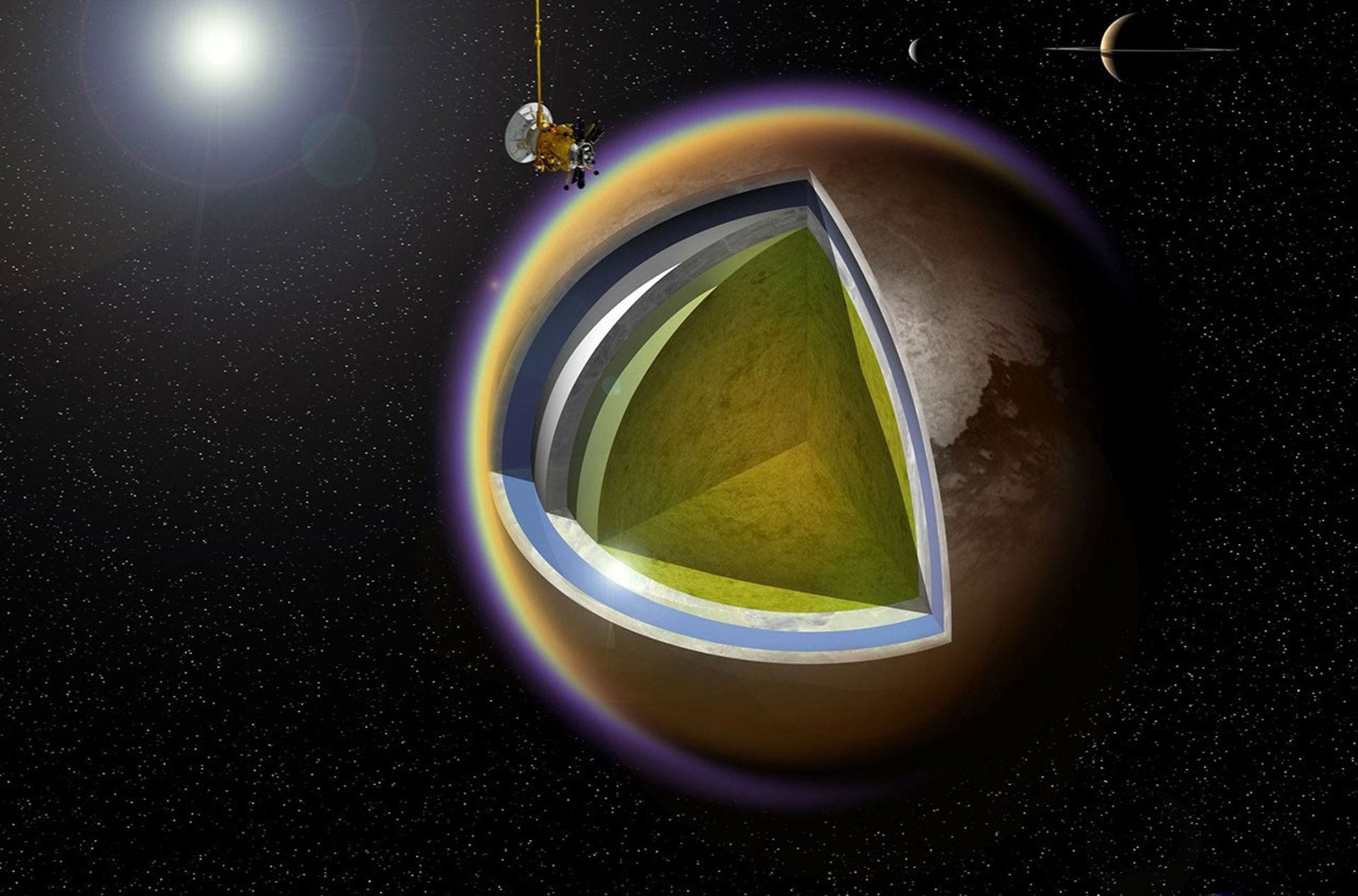
Titan feels familiar, strangely so, and yet it is utterly alien. It has weather. Clouds. Rain. Lakes that splash methane instead of water. It is wrapped in a thick nitrogen atmosphere. No other moon has this. Not even Earth’s sibling in the outer system. It stands alone with this heavy atmospheric blanket.
Scientists care. The place is rich with organic chemistry. It is prebiotic. The stuff that might make life, or remember what life started from. NASA sends Dragonfly there soon-ish, July 2028 maybe, to poke around.
But there is a grittier reason to look up there. Humans want to go. Robert Zubrin called Saturn’s moons the Persian Gulf of the Solar System in his book Entering Space. He wasn’t wrong about the wealth.
A new NASA-backed study puts a number on that idea. It takes Titan’s resources seriously. The team mapped what’s available and asked if it could keep humans alive out there. Compared to Mars or the Moon? Titan wins on resource depth. It just costs a fortune and a long ride to get there.
Who wrote it
Conor Nixon leads the charge. He’s at NASA Goddard. He teamed up with Ye Lu from Worcester Polytechnic and Jennifer Ruliffson at Florida. They put their work online. It’s waiting for Acta Astronautica.
The big focus is In-Situ Resource Utilization. ISRU. Fancy talk for “don’t bring it from home, make it where you are.” Everyone looks at the Moon. Everyone looks at Mars. Titan gets ignored mostly because it’s far away. Until now.
The paper argues Titan can be more than a stopover. It could be a factory. A refueling hub. A gateway to the rest of Saturn’s family.
Think about it. The surface has hydrocarbons everywhere.
“Titan is gushing with hydrocharbons,” Nixon said.
What we call oil and gas here? That’s Titan’s blood. The air is 5% methane. That’s LNG stuff. Cooking fuel on Earth. On Titan it hangs in the sky. Propane. Butane. Kerosene. Gasoline.
You burn them? Sure. You make plastics? Also sure. Synthetic rubber. Solvents. Pharmaceuticals. Food additives. Nixon notes we can literally 3D-print our way to civilization if we harvest enough carbon chains.
Not just fuel
Previous studies looked at one thing: propellant. Geoffrey Landis showed we could liquefy methane and pull oxygen from water ice. Make rocket juice. Simple. Clean. Efficient for sample return missions.
Nixon’s team cast a wider net. They looked at permanent structures. Refueling stations that serve ships passing through, not just ones going home. Maybe you refuel a shuttle going from Enceladus to Mimas. Maybe you top up a tanker heading for Neptune.
Imagine a station on the surface. It doesn’t just store gas. It stores ink. Fertilizer. Raw materials for printers that make spare parts. Utensils. Textiles. A visitor docks not just to fill tanks but to restock their pantry.
Is it realistic? No. Yet. But the math is starting to allow for it.
Water helps. A lot. It’s 50% of Titan’s mass. Most is rock in the core. But water exists. Beneath the surface, it’s liquid thanks to ammonia salts keeping it from freezing. On the surface? Solid ice. Harvest it. Drink it. Split it for hydrogen. Combine with air for oxygen.
The researchers compared Titan to Mars. To the Moon. To near-Earth asteroids.
Verdict: Titan is distant. You need nuclear propulsion to make the transit efficient. It is hard to get there.
But the potential? Unrivaled.
“There is simply no other world like Titan,” Nixon insists.
Only moon with a thick air. Only body besides Earth with atmospheric and surface hydrocarbons waiting for pickup.
The Saturn Hub
Saturn could become the center of everything. Not just Titan. The whole system. Saturn’s own atmosphere holds helium-3. A rare isotope. Fusion fuel gold.
Add that to the water, the carbon chains, the gases. It’s the Persian Gulf, again.
Building a base there isn’t about planting a flag. It’s about building an industry. Manufacturing capabilities that meet human needs for generations. Plastic houses. Grown food. Local fuel.
It is a distant dream. The challenges are steep. Nuclear rockets, life support in nitrogen mazes, extreme cold.
But it’s there. Sitting in the rings’ shadow. Waiting.