Scientists just found real sugar between the stars.
It’s erythrulose. Not a metaphor, not a poetic flourish, a literal, carbon-chain sweetener floating in the dark.
The Milky Way already tasted like raspberries. Or at least it had ethyl formate, that ester that smells exactly like the fruit. Now we have something to sprinkle on top. The galactic center is turning into a bakery, albeit a toxic one.
Don’t reach for it
You can’t eat this snack. Technically the molecule itself is edible. But it’s hitchhiking through clouds thick with cyanide and other things that would make a vampire gag. It’s a beautiful, dangerous mix.
That danger, however, is the point. This stuff might explain where our own biology got started.
“A central question in origin-of-life research is… how monosaccharides formed… laboratory experiments… yield insufficient concentrations.”
Those words come from Izaskun Jiménez-Serra and her team at the Spanish Astrobiology Center. They published their findings in Nature Astronomy. The gap they’re trying to close is huge. Life runs on sugars. DNA and RNA are built on sugar backbones. Cells burn them for energy. Without sugar, you don’t get us.
We knew sugar-like precursors were out there. Glycolaldehyde. Simple bits found in meteorites or near asteroid Bennu. But those weren’t sugar. Not really. You need three or more carbon atoms for that title. Until now, we didn’t know if true sugars formed out in the cold void before landing on Earth.
Looking where it’s crowded
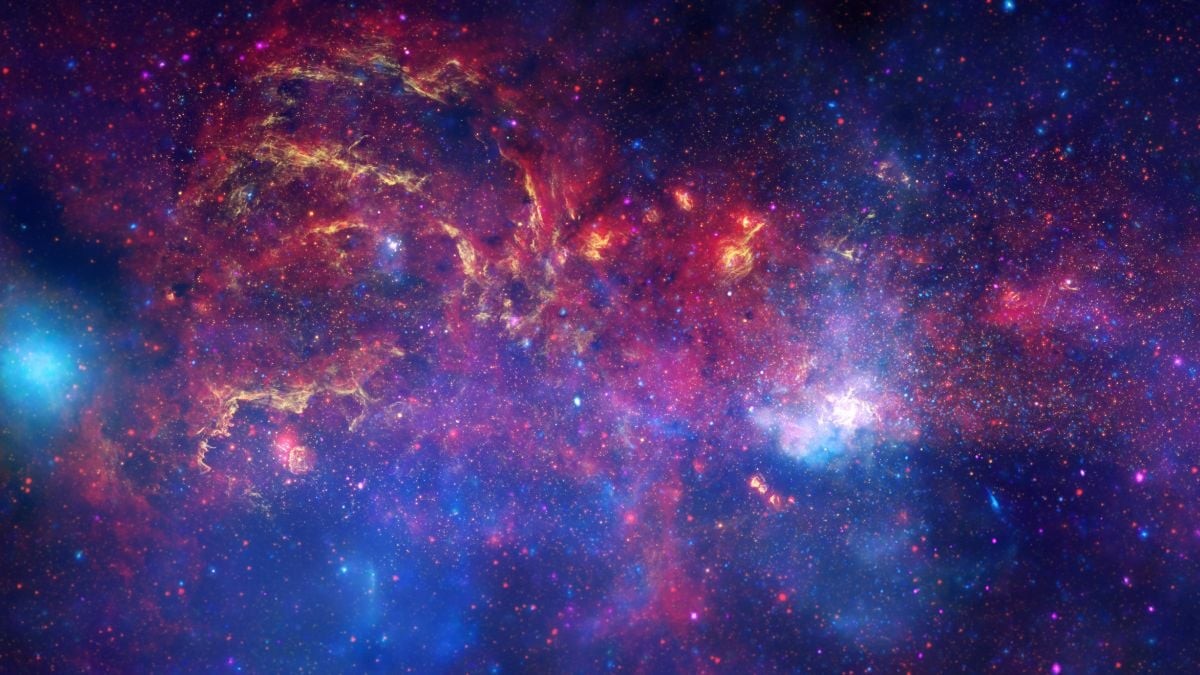
To find something that rare, you have to look in the right place. The Central Molecular Zone. The galactic core. A mess of thick gas, dust, and complex organics. It’s busy there. Chaotic. Promising.
The team pointed two radio telescopes at a cloud named G+0.606. Wait. No. G+0.693. Get your clouds straight.
They scanned for a radio signature. Molecules spin. Each one has a unique radio fingerprint, a hum specific to its structure. You can hear it from light-years away.
G+0.693 sang the tune they were hunting. Erythrulose.
Here is the weird part. The expectations were wrong.
Everyone guessed simple sugars, the ones with three carbon atoms, would win the lottery. Glyceraldehyde. Dihydroxyacetone. Standard suspects. They weren’t there. Not detectable anyway.
Instead? Erythrulose popped out. A four-carbon sugar. And not just a smidgen of it. It was 8 to 17 times more abundant than the trio.
That’s not just a finding. It’s a rewrite of the recipe.
Icing on the cake
So how does it happen? Computer models point to tiny ice grains drifting through the dark.
Glycolaldehyde meets ethylene glycol on these icy surfaces. Radiation acts like the oven. They click together. Bam. Erythrulose forms. Then shockwaves shake the dust cloud, kicking the molecules off their icy perch and into open space. Where the telescopes caught them.
The model numbers don’t perfectly match the reality yet. That happens. The chemistry in space is messy. Future studies will likely fix the math.
But the implications are solid.
Erythrulose is a big deal for other reasons. At 14 atoms, it is the largest acyclic (non-ringed) molecule found in space. Only the second chiral molecule discovered there, period. Chiral molecules are tricky. They have mirror images, left hands and right hands, usually favoring one for life on Earth.
This suggests the interstellar medium can handle complex chemistry better than we thought. Much better.
“…it also takes us to a higher level… suggesting that other prebiotic… molecules could also form and survive.”
Think about where our sun was born. That primordial cloud? If this kind of chemistry works in the galactic core, it probably worked there too. We inherited this complexity. It wasn’t cooked up just in a prebiotic soup on Earth. It came ready-made.
Or mostly ready-made. The question now isn’t if sugar forms in space. We have proof it does.
The question is what else is waiting in that cloud? What other big, weird, life-starting molecules are hiding in the dark, waiting for someone to point a dish at them?